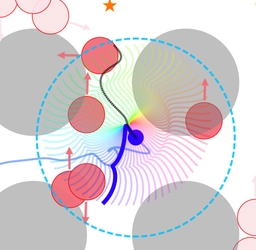

Quadrotor hardware with virtual obstacles (top); physical rover navigation among pedestrians and indoor navigation simulation (bottom).

Can we bring parallelization into safety filters?
We present Policy Library Control Barrier Function (PL-CBF), a runtime safety filter that evaluates fallback policies through parallel finite-horizon rollouts. Among candidates with safe rollouts and feasible input sets, it selects the constraint with the largest admissible input volume, then solves one QP to minimally modify the nominal command. The library provides complementary options as perceived obstacles, models, and constraints change. The method certifies safety on the fly with millisecond-level runtime; no offline value function computation.




Why a single fallback can fail
A braking maneuver can become unsuitable when road friction drops. A fixed evasive direction can become unsafe when another lane is occupied. Changing the fallback may recover one set of situations while losing another. PL-CBF retains multiple options and reassesses their predicted behavior under the current model and constraints.

Safety filters built on one fallback can fail when dynamics or the environment change.
From parallel rollouts to one safety-filter QP

Each policy produces a predicted trajectory and a control constraint. PL-CBF selects a feasible constraint with the largest admissible input volume, then filters the nominal input within that set.
1.
Evaluate the policy library: Roll out each candidate policy over a finite horizon using the current state, model, and perceived constraints. Compute its minimum constraint margin and the corresponding gradient.
2.
Select a feasible constraint: Retain policies with a positive rollout margin and a nonempty admissible-input set. Select the set with the largest volume.
3.
Filter the nominal input: Solve one QP to find the closest admissible command. If the nominal input already belongs to the selected set, it passes through unchanged.
The selected fallback supplies the safety constraint; the QP computes the applied control. The executed trajectory can therefore differ from the selected fallback rollout.
Recovering a larger safe set
In the four-state double-integrator example, stopping, steering upward, and steering downward recover different safe regions. PL-CBF evaluates all three together with the nominal policy.

The same initial-position grid on the velocity slice (vx, vy) = (2, 0) m/s. PL-CBF combines complementary fallback behaviors rather than relying on one fixed maneuver. The black dashed curve is the reference viability boundary computed by Hamilton–Jacobi reachability on the full state space.
Navigation under changing constraints
Together with the safe-set and highway examples above, these studies cover five three simulation settings, from planar motion to nonlinear quadrotor dynamics.
Clearing a hospital corridor
Stopping in a narrow corridor can leave the robot in the path of a faster emergency stretcher. The policy library includes room-entry maneuvers generated online, allowing the robot to enter a nearby room, yield, and resume progress toward its original goal.
When stopping blocks the corridor, room-entry policies let the robot yield.
Across 100 hospital test cases, PL-CBF reaches the goal in 86 with 8.007 ms mean computation time per step, compared with 14 for gatekeeper, the strongest single-fallback baseline in this setting.
Warehouse navigation with limited sensing
A 12-state linearized quadrotor tracks successive waypoints among known static obstacles and moving obstacles that are detected within its sensing range. A library of 64 directional policies, stopping, and the nominal policy provides alternative evasive motions as the free space changes.
The safety filter adapts as previously unseen obstacles enter sensing range.
How does a larger policy library affect safety and computation?
Nonlinear quadrotor flight
Climbing and lateral fallback motions provide alternatives when moving obstacles make hovering or retracing unsuitable.
Complementary fallback policies support evasive flight among moving obstacles.
In the 100-trial nonlinear benchmark, PL-CBF achieves 100% success at 2.464 ms mean computation time per step. PCBF achieves 99%, Backup CBF 85%, and PL-CBF-MI 84% under the same trial conditions.
Hardware experiments
Rover navigation among moving pedestrians
The rover follows successive waypoints among moving pedestrians.
Quadrotor flight with onboard Jetson Orin NX
Its policy library predicts the reference generator, geometric tracking controller, control allocation, and nonlinear vehicle and motor dynamics.
Experiment 1
Experiment 2
Explore our algorithm interactively
The interactive web demos let you change goals, add obstacles, and inspect how candidate rollouts and filtered motion respond in planar, hospital, and quadrotor scenes.
Acknowledgement
This work has been supported by Toyota Research Institute of North America (TRINA), Toyota Motor North America.
Citation
@inproceedings{kim2026plcbf,
author = {Kim, Taekyung and Okamoto, Hideki and Hoxha, Bardh and Fainekos, Georgios and Panagou, Dimitra},
title = {Policy Library CBF: Finite-Horizon Safety at Runtime via Parallel Rollouts},
booktitle = {arXiv preprint arXiv:2605.16588},
shorttitle = {PLCBF},
year = {2026}
}
LaTeX
복사